
Context and Building a Lexicon
“Contexts. Our perception of the world, its structure and nuances constituting it, depends on the context. In our turbulent times – when various contents are interwoven, forming hybrids of real information/facts – it is the context that becomes the only connector between the recipient and full knowledge which can be easily accepted as true. Because we want to assimilate sensations quickly. The meaning of words we use and images deprived of context in the ethos of entities professionally involved in distributing information gets distorted and creates a misleading picture of reality. In the era of optical fibre, thousands of shared hyperlinks and tags, we are unable to conceal information, but we can aptly manipulate it, shape it to lead to confusion or excess, overstate or understate, use it to distract attention or attract to the banal. But what if our only chance for Truth – the context – can also be created by positioning interdependencies between contents, ideas, images and symbols to educate the recipient whose ignorance and apathy are his sole survival strategies? How to grasp yet another piece of information in which violence and fear are juxtaposed with an advertisement promoting exotic, unforgettable holidays in the Far East?”
- Dominika Drozdowska[1]
Why?
Three letters, simple yet profound. A fundamental question we ask ourselves, as humans, as artists. It is the first question we learn to ask, often without understanding the given answers. It is a question we cannot always easily answer, yet dictates how the majority of us lead our lives. From the basic fundamentals of our existence to the in depth understanding of complex mechanisms, it drives our curiosity - making us distinctly human. It is a question that has been answered for millennia, yet is always left unanswered. It is our foundation.
As I begin this writing, it is the eve of the Presidential elections in the United States. I find myself in a state of déjà vu: fearful, anxious, and cynical towards the idea of societal development. It is uncomfortable and unstable. Unexpectedly, I find security here; this is what drives me to create. “No great art was ever created out of comfort.”[2]
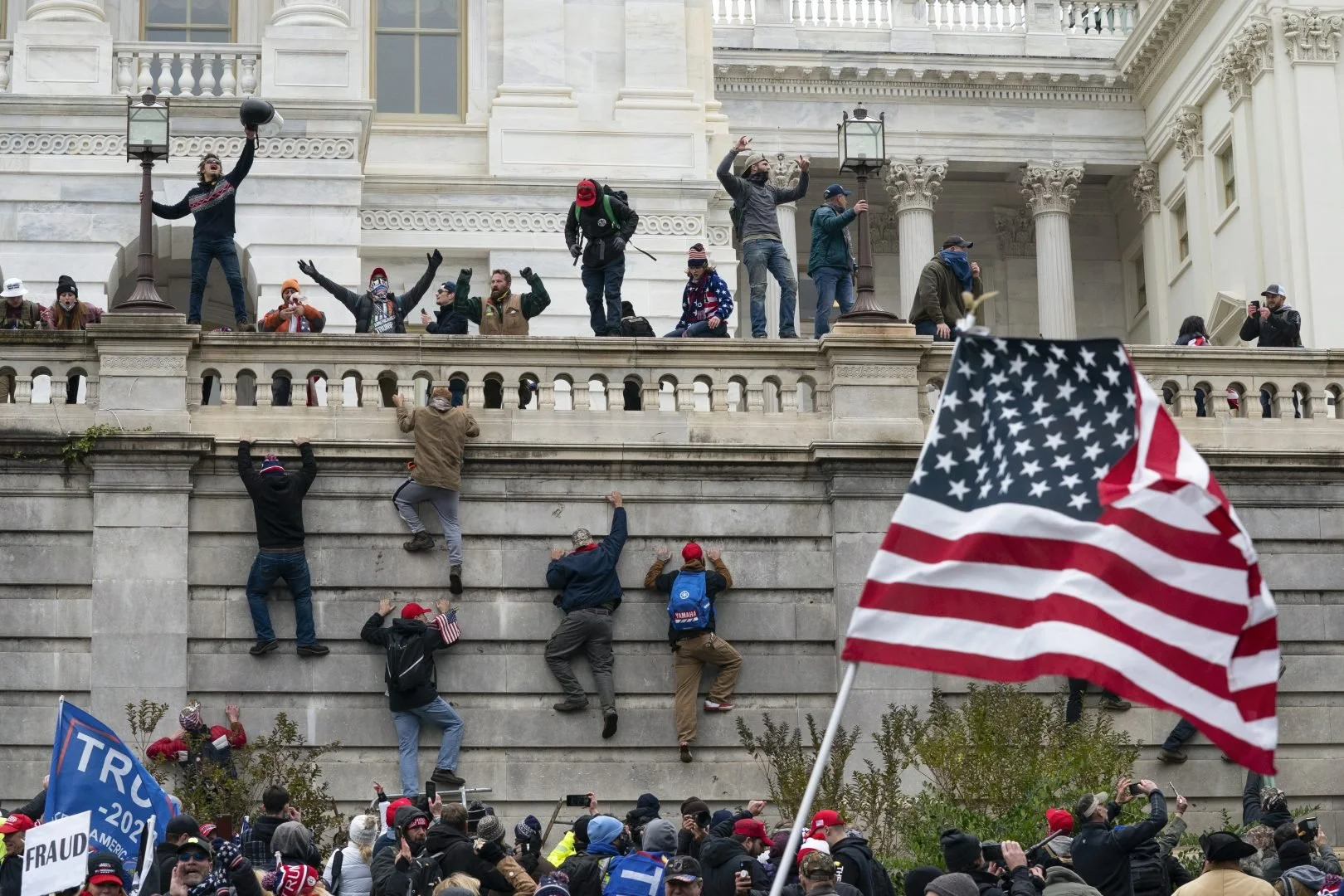
Rioters climb the walls of the U.S. Capitol Building in protest of Donald Trump losing the election. Jose Luis Magana/AP. https://www.npr.org/
Art is a mechanism; it is a tool we can use to express complex ideas, emotions, and discontent offering an alternative to apathy. It is a powerful tool and an important device for social change and political dissent, but it is often neglected. In this chapter, I will attempt to illustrate the significance of politically motivated art accessible in the public sphere and introduce (and in later chapters reconcile) the lexicon of the repetitive imagery I utilize and build a link between the broader theoretical or conceptual ideas and my own connection to them.
As Drozdowska points out, we seek ‘truth’ through context. It is the base for our understanding, but it is constantly being manipulated through media, advertising, entertainment, and political demagogues. Society is often in a state of individual apathetic denial until the point that these individuals are directly affected by the changing state of oppression or zealotry that has again been on the rise in recent years. We sit back and observe as we are entertained by Huxleyan (pseudo) Alphas devolving the fragile equality we believe we have achieved. Our indifference is shaped through our (in)ability to empathize. But this is not to say that we are lacking empathy by nature.
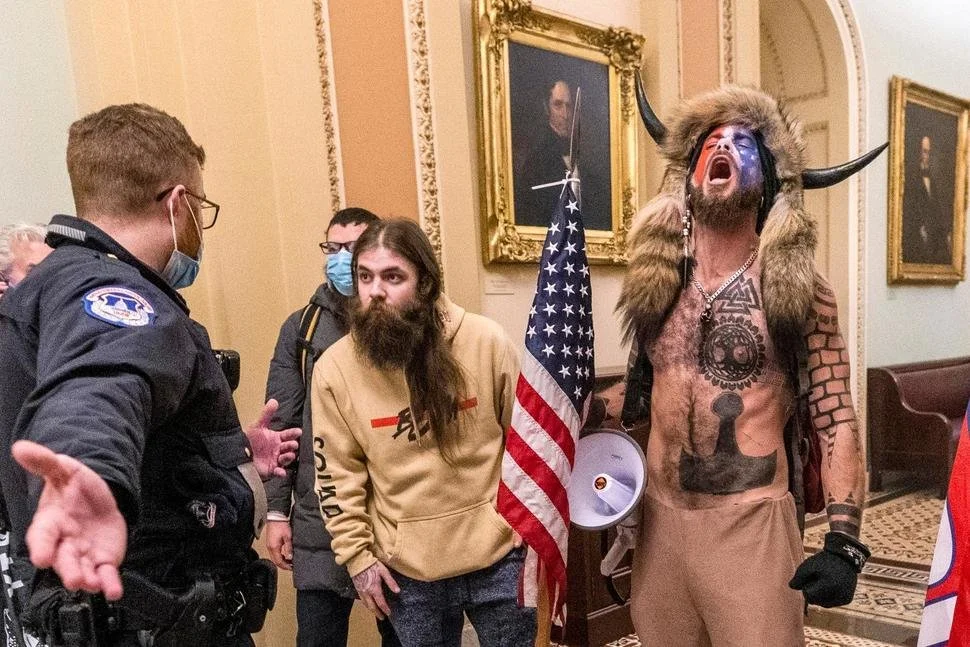
Exemplary Psuedo Alpha Jacob Chansley (right with fur hat) and others are confronted by Capitol Police. Manuel Balce Ceneta/AP. https://www.usnews.com
According to Judith Butler: “The Public sphere is constituted time and time again through certain kinds of exclusions: images that cannot be seen words that cannot be heard. And this means that the regulation of the visual and audible field – along with the other senses, to be sure – is crucial to the constitution of what can become a debatable issue within the sphere of politics.”[3] While she points to the exclusions within her statement, there are certainly other criteria dictating the political; this conversation is equally led by the visual and audio fields that are not excluded and continuously streamed into the public sphere. The democratization of dissent has created a foothold for atomizing society. The belief that one must question everything has become so dogmatic, that it leaves behind the criticality of dissent and leaves one searching for the ‘truth’ by turning only to those who share similar beliefs and perceptions.
In Malcom Gladstone’s book David and Goliath, he addresses the somewhat misconceived notions of the ‘underdog’ citing examples where many individuals overcome their inherent limitations, even in the direst situations. That is not to say that limitations and hardships lead to success, but that in some cases limitations give perseverance and strengthen certain successful individuals. While this sentiment is important and gives hope to individuals who face structural limitations, it also has the counter effect of glorifying the struggle rather than the achievement. We see this glorification become ever more present in the discourse and political rhetoric in the public sphere, especially in more Conservative circles. In regards to Conservatism, I am not referring only to religious or political conservatism but to an overall dependence on tradition and fear or opposition to progress, though in many ways the rhetoric of religious and political conservatives is derived from these principles. To clarify, my thoughts on this are not an attack on conservatism, nor are they a defense of progressive ideology, rather a critique on the inability to break free from the dogmatic rhetorical narrative that is inherently embedded within these doctrines.
“I was given a thorn in my flesh, a messenger of Satan, to torment me. Three times I pleased with the lord to take it away from me. But he said to me, “My grace is sufficient for you, for my power is made perfect in weakness.” Therefore, I will boast all the more gladly about my weaknesses, so that Christ’s power may rest on me. That is why, for Christ’s sake, I delight in weaknesses, in insults, in hardships, in persecutions, in difficulties. For when I am weak, then I am strong.”
- 2 Corinthians 12:7-10[4]
Suffering is the root of all empathy; without having experienced some form of hardship, we lack a fundamental base for empathizing. As I previously stated, I do not believe that individuals lack empathy by nature but our societal perception, and successively the perception of individuals that exist within contemporary society, is superficial. For many the basis for empathy is limited to their own individual experience of hardships or limitations, and the inability to fully relate to those outside their own social or familiar circle.
It is through this celebration of hardship that Conservatism has gained popularity and grown towards oppression rather than the personal freedoms it so cherishes. Gay marriage has become ‘a war on traditional marriage’. The inclusion of non-Christian celebrations has become ‘a war on Christmas’. This rhetoric is used as a device for political gain, but more importantly it continues to atomize our already divided population. This political sectarianism certainly centerstage in American politics, but as the world watches on in disbelief, we see the same sentiment arising across Europe, especially as the UK brexits the European Union and Poland creates LGBTQ free zones.
“One of the great achievements of the doctrinal system has been to divert anger from the corporate sector to the government that implements the programs that the corporate sector designs, such as the highly protectionist corporate/investor rights agreements that are uniformly misdescribed as ‘free trade agreements’ in the media and commentary. With all its flaws, the government is, to some extent, under popular influence and control, unlike the corporate sector. It is highly advantageous for the business world to foster hatred for the pointy-headed government bureaucrats and to drive out of people’s minds the subversive idea that the government might become an instrument of popular will of, by, and for the people.”[5]
The divided populace seeks to vilify those for whom they lack empathy – those with any beliefs in opposition to their own. In this dangerous and hostile environment, empathy is disrupted. “The severity of political conflict has grown increasingly divorced from the magnitude of policy disagreement, requiring the development of a superordinate construct, political sectarianism — the tendency to adopt a moralized identification with one political group and against another.”[6] This sentiment appears on both sides of the spectrum; neither the left nor the right can claim innocence from participation from this doctrinal divide. Our society is again at a point in its existence where the focus needs to shift from each other to ‘the powers that be’. We need empathy. We need recognition.
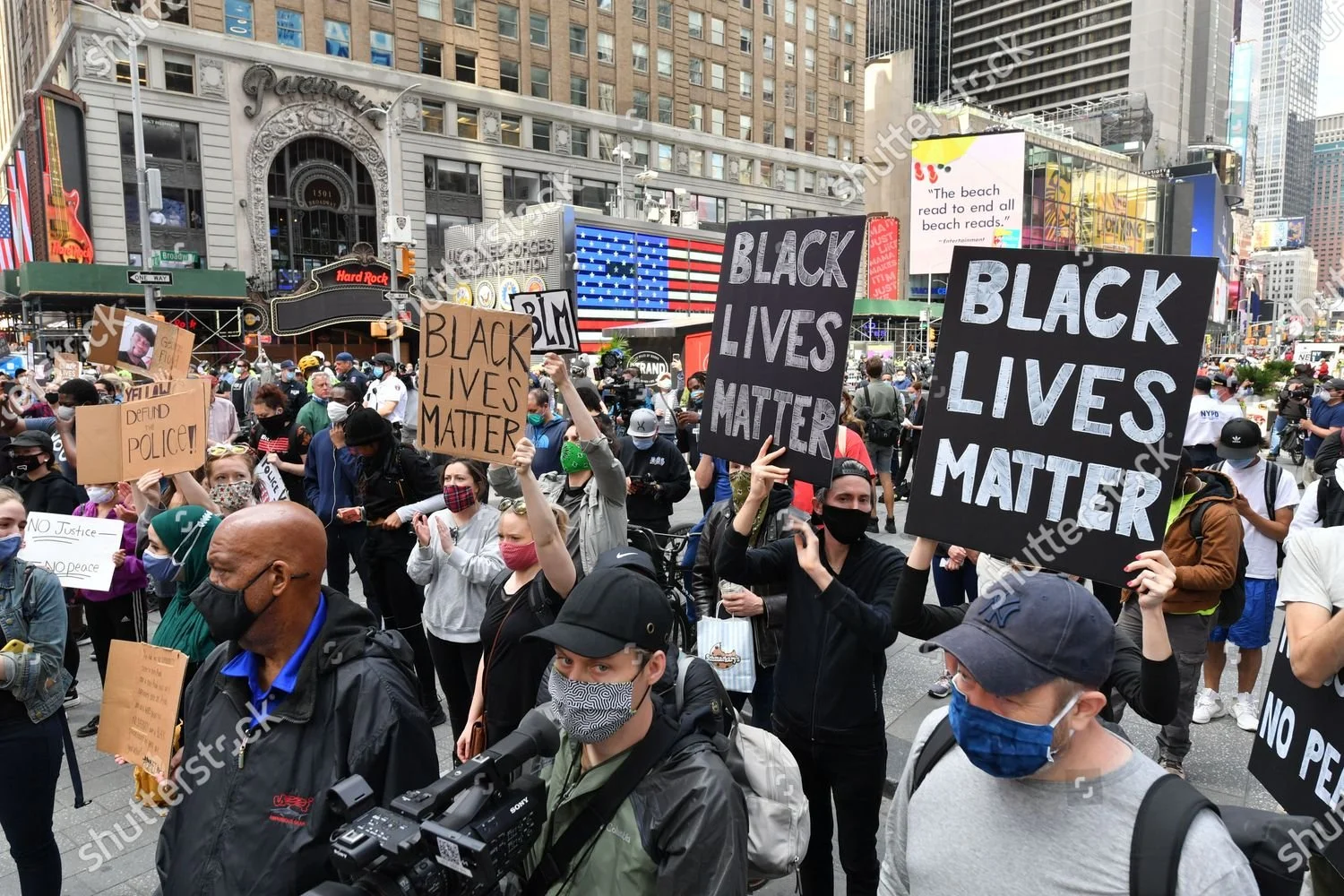
Black Lives Matter demonstrators peacefully protest the murder of George Floyd, a black man kill by police officers in Minneapolis. Alex Brandon/AP. https://www.aljazeera.com
In the contemporary public sphere, analogy is often used in an attempt to invoke empathy through a sense of understanding, but how can this understanding occur? “The suffering of one people is not exactly like the suffering of another, and this is the condition of the specificity of suffering for both. Indeed, we would have no analogy between them if the grounds for analogy were not already destroyed. And if specificity qualifies each group for analogy, it also defeats the analogy from the start. The obstruction that thwarts analogy makes that specificity plain and becomes the condition for the process of pluralization.”[7] It can never be a place of identical circumstances, therefor the sense of understanding is potentially reached through recognition.
If our perception is limited through our own experiences, how can we achieve empathy? I believe we overcome our limited perception at one time or another in our lives. Someone or something we have distrusted or disliked based purely on our individual ignorance, later seeking an escape to our preconceived prejudices when discovering their inaccuracies. We find exceptions, reveling in the sentiment that ‘this one is different than the others’ or ‘that is a good one’. But this is simply an act of recognition; an acknowledgement of our ignorance. This limited perception is where the majority of our societal empathy lies, blind to the experiences of trauma in others unless they correlate with our own, but it can shift. Rather than hiding behind our ignorance, we need to work towards accepting our own hardships without invalidating the trauma of others.
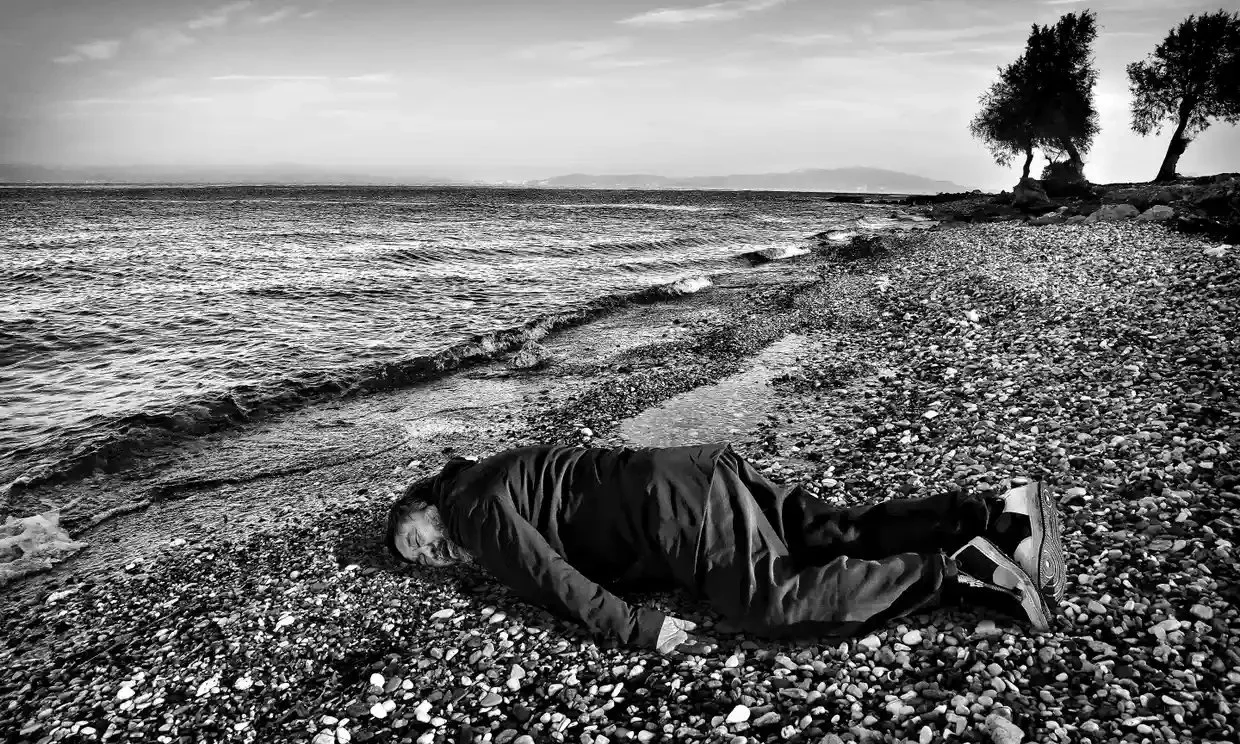
Contemporary artist Ai Wei Wei posing as a dead child named Alan Kurdi on the Greek Island of Lesbos. Rohit Chawla/AP. https://www.theguardian.com/
“How broad, how deep is your empathy? How broad, how deep is one’s own imagination? Right back to Shelley. And most importantly for me – and this is something that makes it difficult for a blues man like myself to remain for too long in an academic context – when you have that kind of orientation, you’re always full of righteous indignation and holy anger at injustice. There’s a sense of urgency, a state of emergency that has been normalized, hidden, and concealed. So you get a little suspicious sometimes of the discourses that can easily deodorize the funk that’s there, that don’t really want to engage the catastrophic, the in which the U.S Constitution didn’t want to talk about the near-genocidal impact on our red brothers and sisters or the slavery of black people and act as if they don’t exist.”[8] – “We must attempt to always ensure that things are not so sterilized and sanitized.”[9]
This is the root. This is the point at which political and socially motivated art begins. We work towards achieving an environment where conversation is possible, even with our given differences and perceptions through a visual simile. Just as dystopian fiction focuses on and intensifies suffering and injustice in future societies in allusion to those within our own society, political and socially motivated art share in this focus. Ironically these dystopian fictions have become so engrained in our populace that they seem somewhat prophetic, further intensifying the need for politically and socially driven artwork in the public sphere. As contemporary art shifts towards beauty and banality through its market driven decent, there must be space for the discomfort of these trends.
Works Cited.
[1] D. Drozdowksa, A Still Life. Curatorial Statement to Exhibition, Wroclaw, SiC! Gallery BWA Galleries of Contemporary Art, 2017. https://bwa.wroc.pl/language/en/events/a-still-life-john-moran-2/ [access: 4.26.2021].
[2] Ben Weinman, The Dillinger Escape Plan. The quote was used in several interviews over the course of the 20 year existence of the Dillinger Escape Plan. I believe Weinman was paraphrasing Joyce Carol Oates “My belief is that art should not be comforting; for comfort, we have mass entertainment and one another. Art should provoke, disturb, arouse our emotions, expand our sympathies in directions we may not anticipate and may not even wish.”
[3] J. Butler, Is Judaism Zionism? Essay in The Power of Religion in the Public Sphere, New York, Columbia University Press, 2011, p. 75
[4] Intentionally used out of context from: M. Gladstone, David and Goliath, London, Penguin Books, 2014, p. 97.
[5] N. Chomsky, Trump in the White House, Essay from Optimism over Despair, Great Britain, Penguin Books, 2017, p. 125.
[6] E.J. Finkel, C. A. Bail, M. Cikara, P.H. Ditto, S. Iyengar, S. Klar, L. Mason, M. C. McGrath, B. Nyhan, D.G. Rand, L. J. Skitka, J. A. Tucker, J. J. Van Bavel, C. S. Wang, J. N. Druckman, Political sectarianism in America, Science Magazine, Vol. 370, Issue 6516, p. 533. http://science.sciencemag.org/ [access: 9.9.2020]
[7] J. Butler, Is Judaism Zionism? Essay in The Power of Religion in the Public Sphere, New York, Columbia University Press, 2011, p.87
[8] C. West, Prophetic Religion and the Future of Capitalistic Civilization, Essay in The Power of Religion in the Public Sphere, New York, Columbia University Press, 2011, p. 97.
[9] Ibidem.